Approaching the Singularity Point

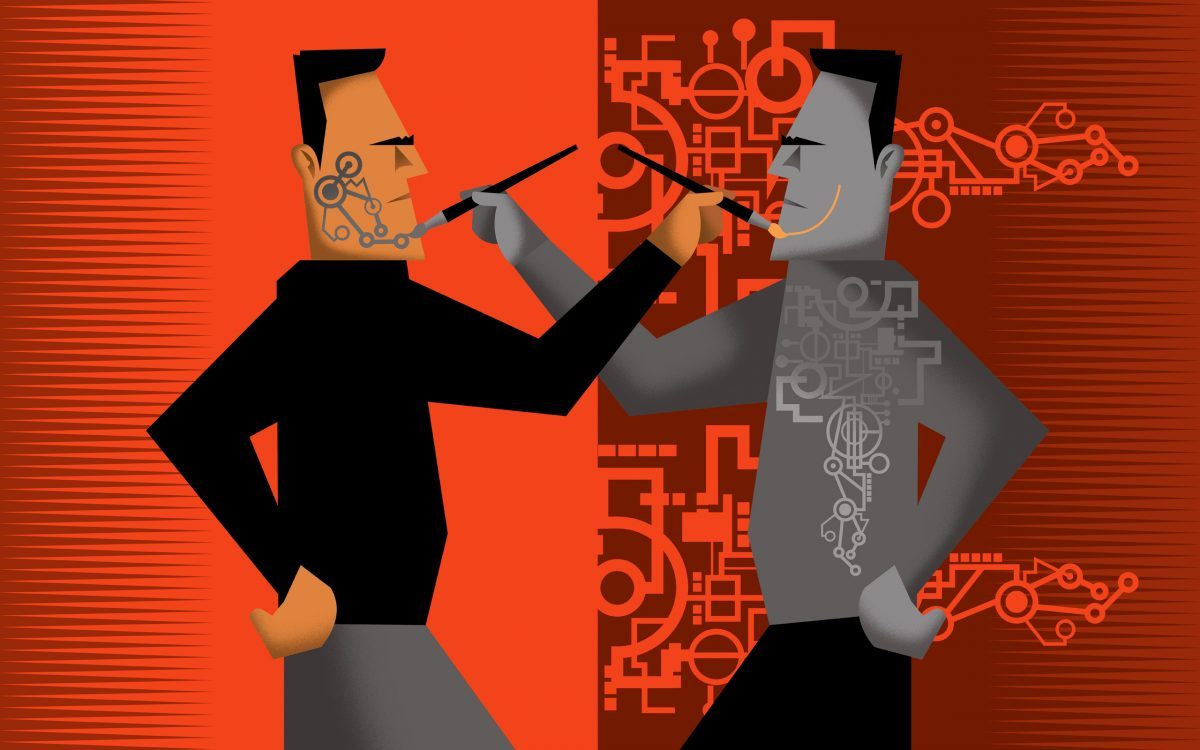
The singularity is a point where conventional rules break down and predictability collapses. It manifests across our intellectual landscape in remarkably consistent ways. In mathematics, singularities mark where functions explode to infinity or become undefined, revealing the boundaries of analytic methods. In physics, they represent the extreme conditions at black hole centers and the universe’s origin, where spacetime curvature becomes infinite and our best theories fail. Engineers encounter singularities as critical failure points: robotic arms losing control authority at certain configurations, stress concentrations approaching infinity at crack tips, or control systems becoming unstable at specific parameter values. Yet perhaps nowhere is the concept more consequential – and contested – than in the realm of technology and artificial intelligence, where “the singularity” has become shorthand for a hypothetical inflection point that could fundamentally redefine human civilization itself or, arguably, bring it to an end.

Source: https://www.kaspersky.com/blog/secure-futures-magazine/technological-singularity/32158/

In computer science and futurism, the singularity represents a predicted moment when artificial intelligence surpasses human cognitive capability and enters a recursive self-improvement cycle, accelerating technological progress beyond our capacity to understand or control. It does not have to actually surpass the human intelligence – the control of the narrative is more than enough especially when the existing narratives are challenged and easily cancelled. Continue reading “Approaching the Singularity Point”

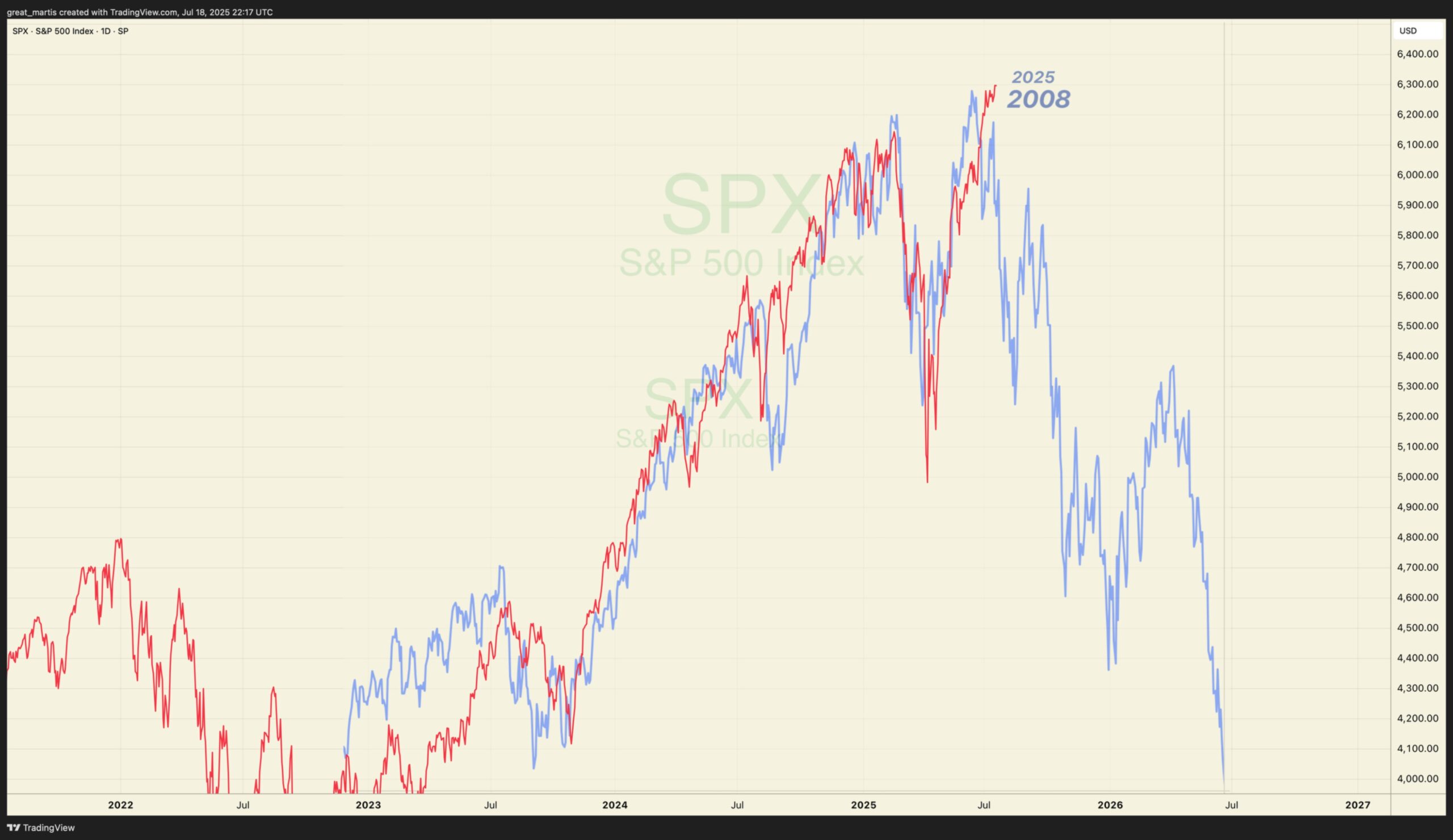
Systemic crisis: S&P 500 performance 2008 to 2025

The past 20-25 years are interesting because of the frequency of economic crisis that become rather frequent, way more frequent than they should be. The economic model is in a systemic crisis, which shows in symptoms. Here is an interesting one – the overlay of 2008 to 2025 S&P performance. Since, the roots of the problem were not addressed when they were still manageable with little blood in 2008, the bleeding will be worse now. The common sense says, you can hide the dust under the rug, but there is just that amount of dust, which the rug can hold until it can not anymore. The 2008 solution delayed the crisis, but not fixed it. And sure enough, there is the pendulum effect – the more one postpones the settlement, the harder it will hit back.

Source: https://x.com/great_martis/status/1946334242881040791

What are our future prospects? The answer from Peter Frase’s “Four Futures” book

The current global landscape presents a deeply contradictory and bewildering picture. The sensation that the world has gone mad is reinforced by the simultaneous coexistence of mutually exclusive trends. On the one hand, declarations are heard about the end of capitalism in its traditional form, based on infinite growth, as capital has reached its limits of profitability. Concurrently, we are witnessing the end of globalization and a shift towards region-centrism, which exacerbates geopolitical tensions, – something I was talking about back in 2020. On the other hand, there are high expectations for the Fourth Industrial Revolution and artificial intelligence, which lay claim to the role of a new engine of progress. However, this technological optimism exists against a backdrop of numerous military conflicts, accompanied by rhetoric about “peace,” which only heightens universal distrust and the perception of other actors as a threat—an attitude that has become the norm in this transitional period. Statistics reveal a deeply challenging condition for individuals: economic pressures threatening unemployment and income loss are battering not only the lower but also the middle class globally, with fewer jobs being created. This distress fuels a retreat from living the life in its complexity into substance abuse, gaming, and porn, mental health issues, suicides, leading to declining demographics, radicalization of views, and widespread dissatisfaction. The once-omnipotent media, which previously managed to channel the narratives, is now losing its means of message control – the trust is in true scarcity.

The entire world is, in essence, in a state of transit towards a new economic, political, and technological order. Searching for a framework to perceive the happening, I stumbled at Peter Frase’s book Four Futures. Frase uses “social science fiction” and “ideal types” to map out four possible post-capitalist worlds based on two variables: the level of scarcity or abundance (ecological crisis) and the level of hierarchy or equality (class power). While the author argues – or perhaps hopes – for a positive synthesis among the alternative future models that may lead to a solution that favors the humane development, personally I am less optimistic given the traceable record of the past decisions of the elites to choose and pursue self-interests ultimately bringing the inevitable just to maintain the status quo. I believe, we rapidly approach the point of singularity, where “either/or” will happen with only 2 variables on the table – 1 and 0.

I hope you took the bite, so let me briefly present the Frase’s future options adding a few of my thoughts on top of the topic.

Four Futures: Life after Capitalism

  • Communism: Equality and Abundance

This scenario envisions a post-scarcity utopia where high automation has eliminated the need for human labor.

Continue reading “What are our future prospects? The answer from Peter Frase’s “Four Futures” book”

The Culture of Rush and Slow thinking

Slow down! This is going to be a long post, but it is worth you time. If you are in a rush, go down to the last paragraph.

In a world of a constant rush, who is doing the slow thinking for you?

THESIS
It’s not just your imagination. The pace of life is accelerating in spite of all of the conveniences that we are exposed to, such as airplanes and fast trains, quick cars, productive computers, smart phones, smart houses, Internet with its instant availability, dishwashers, laundry machines, mixers, smart and functional food processors, robotized lawn mowers and abundance of other tools that are supposed to free up the time. The same is the situation at work, where work processes, production schedules and pressure to commit to rapid decision-making require an immediate action. This trend is nurtured in the public culture with its rapid-fire news cycles and next-day delivery to “speed-watching” videos and the relentless pressure to be more productive, we are all caught in a current of increasing speed. While often exhausting, this trend is not arbitrary. However, a solid question retains its validity whether we recognize the rush or not: towards what are we all rushing… towards what and, most importantly, what for?

The rush culture is built by the environment around us. It builds on an interesting connection to the processes of our individual, internal thinking with an outcome which is not pretty. The persistent rush is the logical outcome of a powerful convergence of technological, economic, and social forces affecting our fast and slow thinking (processes described by Daniel Kahneman) in a way that makes sense, while making no sense. Such duality is absurd, but it seems that humanity as a kind and its individual agents somewhere along the way gave up and embraced all of the absurdities to be able to discern any and more importantly do something about it. Please, follow me and I will show you what I noticed in a minute or so.
For simplicity, let’s consider these three reasons why our world is systematically speeding up – the technological, economic, and social forces. I am sure, these dimensions are not exhaustive, but sufficient to see the pattern and patterns is what matters, when one tries to see a bigger picture.

Technology is the primary driver of acceleration, creating and then catering to an expectation of immediacy. It establishes the feedback loop of instant gratification. Do you remember the clicking sound of the modem on your Windows 95 PC dialing the network provider and how long it took to load a webpage or download a favorite song? We’ve moved from dial-up internet to 5G. A delay of a few seconds in loading a webpage or video is now considered unacceptable. This eradication of technological waiting has rewired our patience, making us expect the same instantaneous response from other facets of life. Now, couple that with social media and news feeds powered by algorithms that prioritize engagement. Content that is new, shocking, or controversial gets pushed to the top, creating a relentless, 24/7 news cycle. The race for clicks and views incentivizes a faster churn of information, leaving little time for reflection. On top of that, the wide spread of productivity software, communication platforms, and automation tools, which are designed to help us do more in less time, did not produce more free time for its users. In fact, we end up in the “productivity paradox”: instead of creating more leisure time, we simply fill the saved time with more tasks, raising the baseline expectation for output ending up in a ferocious rat race chasing the undefined “better life”.

Continue reading “The Culture of Rush and Slow thinking”