Craving for simplicity

Some time ago I found the “needs and ideas” image below while browsing for some engineering related memes. First, found it funny, but after a thought the fun faded. This little image reveals the universal law of the modern world: The Law of Complicated Answers to Simple Questions.

Source: somewhere online

You know the feeling. You’re humming along in life, and a small, perfectly reasonable need pops into your head. Something like, “I wish I had a simple way to jot down a grocery list.” So you go looking for a solution. You type “digital notepad” into a search bar, and what you find is… an existential crisis.

You are no longer looking for a notepad. You are now evaluating a “Multi-Sensory, AI-Powered, Cross-Platform Synergistic Life-Management Ecosystem.” It doesn’t just hold your list for milk and eggs. It wants to analyze your purchasing habits, predict your future avocado needs, share your list with your fridge (which you don’t have), and send motivational quotes to your smartwatch when it detects you’re lingering too long in the cookie aisle.

All you wanted was to remember the bread.

This phenomenon is everywhere. It’s like every company is terrified of creating something that is merely excellent at one thing. They’re in a relentless race to add features, convinced that we, the consumers, are desperately crying out for more bells and whistles.
Why so? Continue reading “Craving for simplicity”

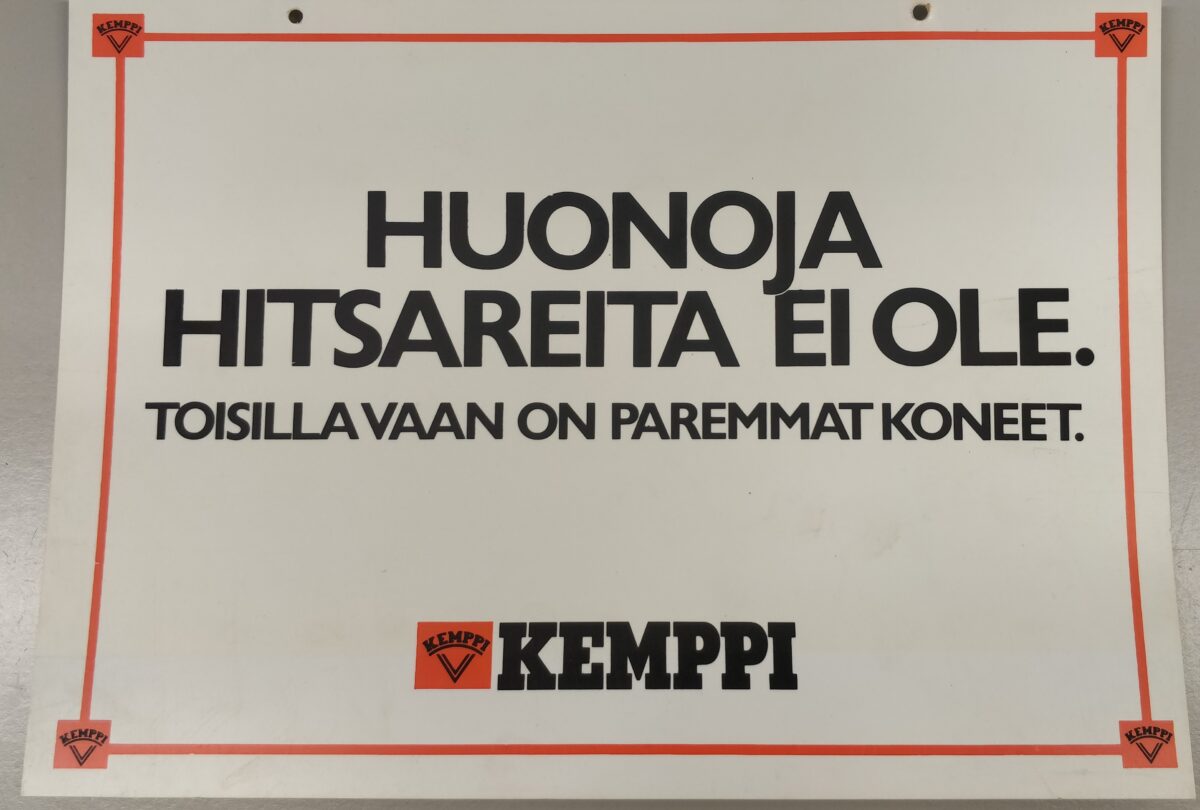
Old school marketing by Kemppi

This is truly the essence of Finnish marketing. Took this photo in a testing lab, while working at Kemppi. Engineers are the gem of the company. They are the people who make “the miracle of welding” happen and they are the greatest mythologists/marketers.

The message says:

“There are no bad welders – some just have better machines. Kemppi”

Classic!

Marketing hypocrisy: customer needs – what firms actually aim to meet

No matter what sweet marketing reasoning says (Levitt, Kotler and alike), firms do not seek a customer per se, as a human, for who customer is with his life, troubles and routine to help him (see profound discussion by Fromm 1994). These issues are left to government backed social care and church at the best. See how many customer needs are ready to be met around the globe and too few companies ready to meet them because there is no financial interest – the customer needs need to match companies’ goals. Firms seek a customer that will buy their product. It is not the customer needs that company aims to meet. Contrary, it is company goals a firm aims to meet by addressing dehumanized customer demands (Fromm 1994). In such context, customer need is of any interest as long as they allow gain opportunities. Just as companies are not interested in customers per se, customers are equally interested in companies only for the reason of a product. The correct stress and priorities changes the tune; it scatters marketing tinsel away leaving crude reality.

And the reality is plain: companies sell products, be that goods, services, know-how, even when they are dreams. Product is the finite outcome of organization’s existence. The transfer of value from firm to customer and from customer to a firm is the blood that runs through the veins of economy. All activities of a firm directly or indirectly support the goal of facilitating transaction of values – money for product. No transfer – no customer. It is “Capitalism 101.” The role of marketing is to convince the fool to trade – the rest is lyrics.

Fromm, E. (1994). Escape from Freedom (repring, r). Henry Holt and Company.